Bring a Dictaphone, Not a Brief: Making Art With Repair Cafés on Their Own Terms
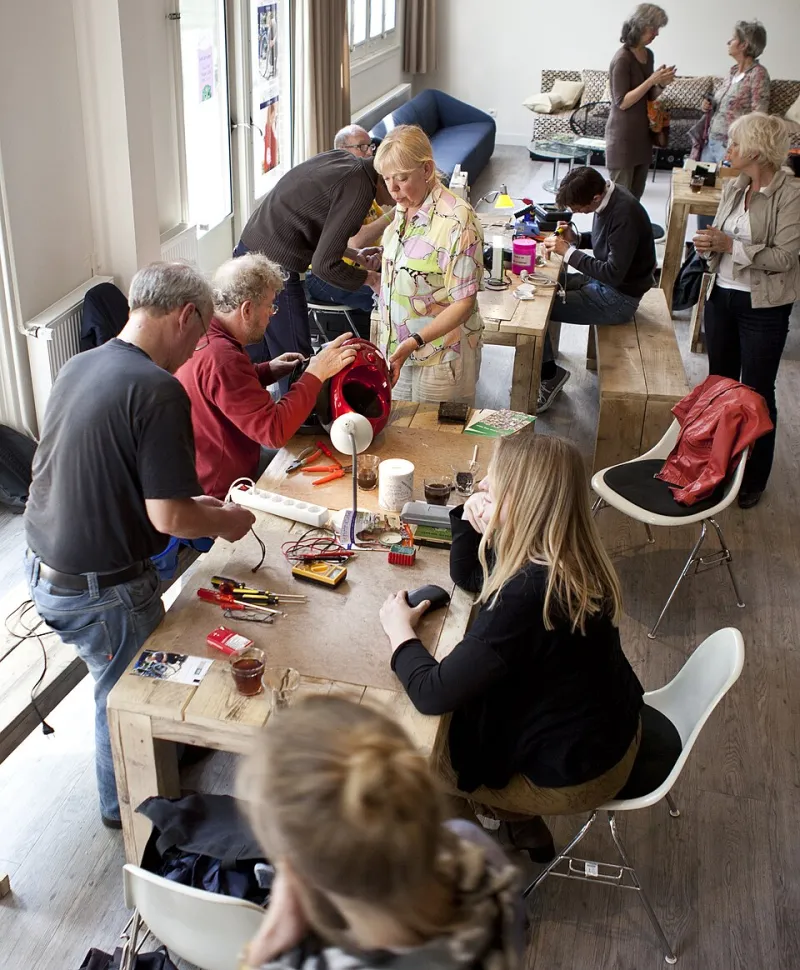
Photo: Ilvy Njiokiktjien, CC BY-SA 3.0, via Wikimedia Commons
Repair cafés are one of the quiet successes of UK community life. You will find them in church halls, library meeting rooms, scout huts and the back of a bike workshop: tables of volunteers with multimeters, soldering irons, sewing machines and the kind of patience that only comes from having fixed the same kettle model forty times. They are not a venue waiting for an artist to animate them. They are infrastructure. That is exactly why they are worth working with.
Start with the kettle, not the concept
If you want to make work with a repair café, turn up first as a person with a broken thing. Book a slot, bring your faulty lamp or your mum’s CD player, and watch how the room works. Notice who greets people, where the queue forms, how decisions get made, which volunteer is the unofficial archivist of spare parts. Do not arrive with a deck. Arrive with curiosity and a willingness to be the least useful person in the room.
When you do approach the organiser, ask what would make their Saturday easier. Sometimes the answer is help with tea. Sometimes it is better signage. Sometimes it is a photographer who actually understands consent. The project should begin as an offer, not a request for access. That shift matters. It is the difference between collaboration and a location shoot.
Consent is a process, not a form
Repair cafés are full of brilliant stories, but they are not a content farm. The volunteer explaining capacitor failure is not there to perform for your camera. The person who has brought in a broken heirloom is having a private moment in public. Record accordingly.
Ask three times: the organiser, the volunteer, the owner of the item. Explain where the material will go, how long it will exist and how someone can withdraw. Use plain language, not a four-page release form shoved under a nose. A simple consent card with large type and a QR code to a fuller explanation is often enough. Put a sign at the door, but do not rely on it. Ask again when the recorder is actually running.
If someone says no, the project has to be able to survive that. Build in alternatives: hands without faces, audio without names, a still life of the opened toaster instead of a portrait of its owner. GDPR is not a personality trait, but it is also not optional. Keep files organised, delete what you do not need, and do not upload raw footage to a group chat because it is convenient.
Make outcomes that stay in the room
A repair café collaboration works best when the art has a life beyond the launch night. Audio portraits are a good fit: three to five minutes of a volunteer talking through a repair, mixed with the clicks and whirs of the bench. They can play on a listening post at the next session, on community radio, or through a local library’s podcast feed. Photo essays work too, but only with proper consent and a commitment to showing the images back to the people in them before they go public.
Live broadcast is another option, especially if you partner with a community radio station or a library with a small media suite. Keep it low-fi and honest. A 30-minute show made from the sounds of a repair café, with volunteers choosing their own music between segments, can be more affecting than a polished documentary. The point is not to explain the café to outsiders. The point is to let the café’s own rhythm become the material.
Whatever form you choose, leave something behind. A zine of repair stories. A set of audio pieces the organisers can use at future events. A photo display that lives in the hall. If the only artefact is your portfolio, the collaboration is already out of balance.
The kit and the choreography
You do not need much: a decent handheld recorder, a clip-on mic, headphones, spare batteries, a notebook and consent cards. Bring gaffer tape and label everything. If you are filming, keep the setup small. One camera and one person is often better than a crew. Repair cafés are busy, slightly chaotic spaces, and a large production can turn a community event into a set.
Work with a volunteer host. Ask them to introduce you, not the other way round. Agree time limits. Do not interview someone mid-solder unless they have said it is fine. Have a quiet corner for longer conversations. If young people are involved, follow the organiser’s safeguarding policy and do not assume a parent’s nod is enough. Access matters too: captions for any video, transcripts for audio, a seat for anyone who needs one, and clear information about stepping out.
Money, access and the awkward bits
Budget for the café, not just the art. That might mean paying the organiser for their time, covering volunteer expenses, buying tea and biscuits, or funding a proper thank-you event. Ask about public liability insurance and PAT testing before you bring electrical equipment into the room. Check access to the venue: step-free entry, accessible toilets, parking, bus routes. If you are broadcasting, agree who owns the recording and how the café can use it later.
Do not treat community skill networks as free labour. The repair café movement has spent years building trust. Artists who borrow that trust without reciprocating make the next collaboration harder for everyone. Be the person who turns up on time, credits people properly and sends the files when you said you would.
Why this is studio practice
The most interesting work often happens when the studio stops being a room and becomes a set of relationships. A repair café already contains an intergenerational skill exchange, a social space and a live demonstration of how things work. Your job is not to import a project onto that. Your job is to notice what is already there, ask what would help, and make something that gives the room back to itself. Bring a dictaphone, not a brief. The fix is already in the room.