Chairs in a Circle Won’t Save You: Notes on Running Workshops With Actual Nerve
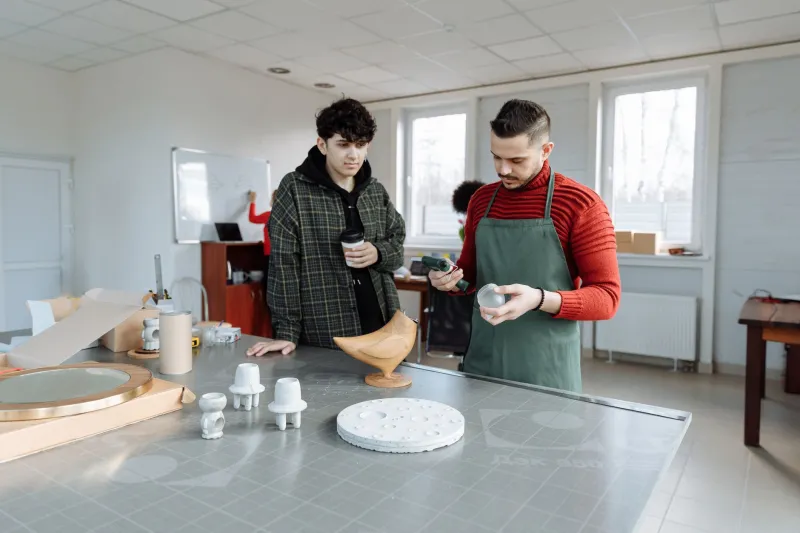
I have sat through too many sessions where the word ‘creative’ meant a stack of coloured Post-its and a facilitator asking everyone for ‘one word that sums up your practice’. The work did not need a lanyard. It needed a room, some proper materials, and permission to get on with it.
At Gina Cross Projects, workshops are part of studio practice, not a customer-service add-on. Whether you are running a zine afternoon in a village hall, a crit in an arts centre, or a movement session in a community room above a shop, the same question applies: are we making a place where work can happen, or are we staging the appearance of participation? The difference is mostly practical.
Start with the room, not the agenda
Before you write a running order, go and stand in the space. Where is the light? Can you move the tables? Is there a kettle, and is it actually usable? Are the chairs the kind that squeak every time someone shifts? A hotel conference suite will fight you all day; a slightly scruffy community hall will often be more honest.
Default to a making layout, not a presentation layout. Chairs in a circle are fine for conversation, but they are not a magic spell. If people are cutting, gluing, drawing or handling objects, give them tables and elbow room. Put materials where they can be seen and reached. Leave a wall for work in progress. Make one corner obviously for quiet thinking. The room is the first material you are working with, so treat it like one.
The invitation is the first facilitation
Most workshop problems begin in the blurb. If your invitation says ‘unlock your creative potential’ and ‘step outside your comfort zone’, you have already set a slightly pushy tone. Say what will happen, what will not happen, who the session is for, what it costs, what access is available, and whether people will be asked to share. Plain English beats aspirational fog every time.
I like an invitation that treats people as practitioners, not delegates. ‘Come and make a rough pamphlet with us’ is clearer than ‘a dynamic co-creation experience’. Tell them whether they need experience. Tell them if there will be photography. Tell them they can leave at any point. And if you are charging, say so early and say what the money covers. Transparency is not admin; it is atmosphere.
Icebreakers are usually a confession
If the first thing you ask a room to do is a trust fall or a ‘fun fact’, you are telling them you do not trust the work to hold the session. You do not need to trick adults into being comfortable. You need to give them a clear, low-stakes way in.
Use a warm-up that is actually part of the practice: a five-minute noticing exercise, a mark-making prompt, a quick object-handling task, a one-line written note kept private. If names matter, do a simple round and move on. Do not ask people to disclose health conditions, childhood memories or ‘what creativity means to them’ as a bonding exercise. Consent is not a vibe; it is a practice. Offer opt-outs and mean them.
Materials should invite decisions
Bad materials make people cautious. Good materials make people curious. You do not need an expensive kit, but you do need enough of the right things: paper that takes ink, scissors that cut, glue that sticks, pens that work. A ‘might be useful’ table of odds and ends is often more generative than a perfectly matched set of supplies.
Avoid kits that prescribe a single outcome. If every person leaves with the same folded object made from the same pre-cut template, that is not a workshop; it is assembly. Budget for waste. Let people use the good stuff. Put out a few things you are not sure about. The moment someone asks ‘can I use this?’ and the answer is genuinely yes, the room changes.
Pace for attention, not throughput
Corporate sessions are designed around throughput: energiser, breakout, feedback, action points. Creative work needs a different rhythm. Build in long enough blocks to actually get somewhere. Put in breaks before people need them. Do not fill silence with motivational chatter. A facilitator who can sit quietly for ten minutes while people work is worth more than one with a whistle.
Have a loose running order, but do not treat it as a train timetable. Leave twenty minutes of slack. End with an optional share rather than a compulsory presentation. Protect the last half-hour for people who want to keep going, and let everyone else leave without a group hug.
Watch the jargon, and the camera
Words like ‘journey’, ‘ideation’, ‘brave space’ and ‘safe space’ do a lot of work in the wrong direction. If a space is not actually safe, calling it safe is worse than saying nothing. Be concrete: ‘This is a quiet room with step-free access and a loo on the same floor.’ Say what you can guarantee.
And decide your documentation policy before the day. Ask permission, offer a no-photo sticker, explain where images will appear, and credit people properly if their work is shown. Nobody should have to negotiate their own image while holding a glue stick.
A checklist for keeping it honest
- Visit the room and test the acoustics, light and kettle.
- Write an invitation in plain English, with access and consent info.
- Say what people will make, not what they will ‘unlock’.
- Skip the trust fall; use a warm-up that belongs to the work.
- Put out more materials than you think you need, and let people choose.
- Build in quiet time and an early exit.
- Ask before photographing anyone or their work.
- Leave space for the unfinished thing.
A workshop is not a corporate away day with better stationery. It is a temporary studio, and it works when the conditions are real. Keep the lanyard in the bag. Put the good paper on the table. Let the work have the last word.