Objects That Survive the Walk Home: A Checklist for Artist Multiples
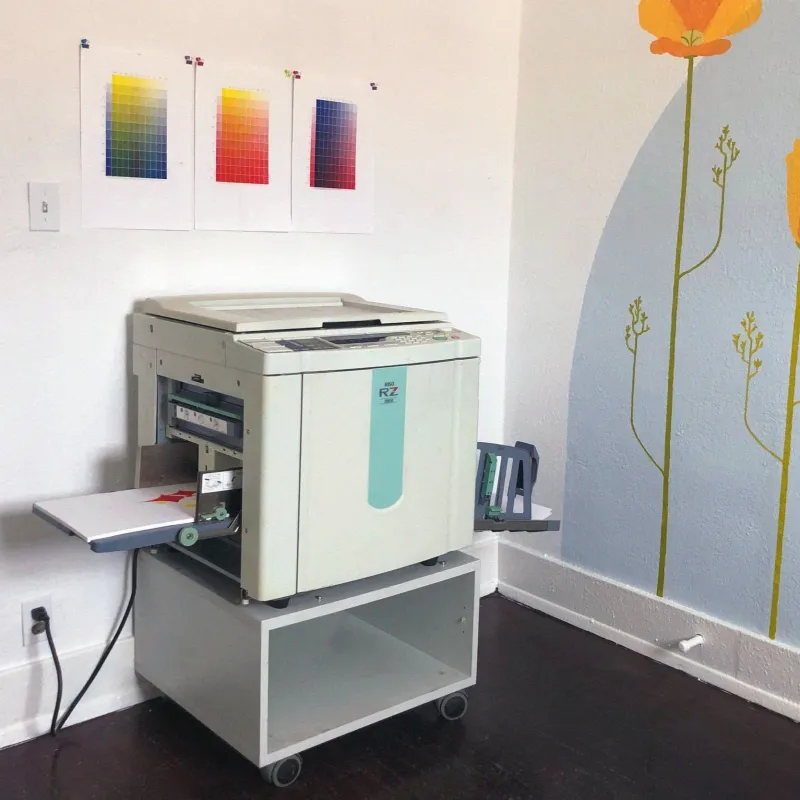
Photo: risograph printed posters and paper ephemera on studio table, via images.squarespace-cdn.com
Every show produces leftovers. The question is whether they're the sort of thing that ends up in a bag under the bed or the sort of thing that turns up on a windowsill two years later in a photo you didn't take.
Here's the working checklist we use when a project needs an object to leave the room with. It's not exhaustive, and it's not precious — but it's all been learned the expensive way.
Start with the carry test
Before you design anything, imagine it in someone's hand on a wet Tuesday in Sheffield, on the bus, in a coat pocket with a set of keys. If it doesn't survive that, it isn't an object, it's a leaflet with ambitions.
Three questions:
- Does it fit in a coat pocket, a small tote, or a back pocket without bending?
- If it gets rained on, does it still work?
- Would you personally keep it if you found it in a pile of free stuff?
If any answer is no, redesign rather than print.
The shortlist, ranked by how often it works
The fold-out poster. A3 folds to A5, or A2 folds to A4 if you score it properly. Cheap to print digitally in runs of 50–100, survives a bag, and has a second life on a wall. Put the useful information — the title, the collaborators, a link, a date — somewhere it still reads when folded.
The riso-printed pamphlet or card. Two colours, uncoated stock, 300–350gsm minimum. Riso looks like it was made by a person, which is usually the point. Runs of 100 are realistic in the UK at a few pence each; ask your local riso studio about offcut stock before you buy new.
The heavy paper band or belly band. Wraps around whatever else you're giving away, carries the credits, costs almost nothing, and is far nicer than a plastic sleeve.
The enamel badge. More expensive per unit, but nothing else survives British weather, keys and the bottom of a rucksack quite so gracefully. Order 50, sell at £5, and they'll go.
The tea towel. Undervalued. Genuinely useful, survives the wash, and hangs in kitchens where people will see it every day. Screen-printed short runs are possible through community print studios.
The seed packet or recipe card. Small, cheap, domestic, and dies with dignity if nobody takes one. Only works if the content is real — an actual seed variety that grows in this climate, an actual recipe someone in the project actually cooks.
The USB or card. Only if there's genuinely a body of work to hold. Otherwise it's landfill with a logo.
Weather is a design constraint, not a footnote
Uncoated paper goes soft at the edges in a damp coat. Staples rust, and rust migrates onto the page. Gloss laminate cracks at the fold. Adhesive labels lift in a cold room and won't restick.
So: uncoated stock with a heavier weight beats gloss; saddle-stitching beats staples if the piece is meant to last; paper bands beat polybags every single time. And no glitter. Ever. Glitter is a material that gets into everything and apologises to no one.
Credit people properly, on the object
Multiples are the easiest place in a project to be quietly unfair. The designer, the printer, the person who folded 200 of them on a kitchen table, the translator, the access worker, the photographer — if they touched it, they go on it.
Practicals:
- A short colophon block on the back or inside flap: who made what.
- Full names, not just first names, unless someone has asked otherwise.
- A pay line if it's relevant — a small 'paid' or 'volunteer' note is good practice and increasingly expected.
- An access note: alt text on any digital version, large print available on request, and a plain-language line about what the object is.
Budget it like a short run, not a merch table
Do the maths backwards. Decide the total you can spend, divide by the cost per unit at your print shop's actual tier boundaries, and see what number you land on. Runs of 50, 100 and 250 are the usual price cliffs; 137 is not a tier, it's a rounding error you'll pay for.
A rough UK rule of thumb for a small project: £150–£300 covers a decent run of a folded poster or a riso pamphlet plus a paper band. Add badge-making at about £1–£2 a unit. Then decide which single object you can actually afford to do well, and do that one instead of three things badly.
Give it a reason to be taken
Objects left on a table with a handwritten 'please take one' sign vanish. Objects with a small printed card explaining what they are and why they exist get taken thoughtfully. Put them near the exit, not the entrance, so people have already decided they want to carry something.
And keep a dozen back. You'll want them for the archive, for the funder's report, and for the person who emails in March asking if there are any left.