Sign Here, Both of You: Writing a Shared Artist Statement Nobody Has to Distance Themselves From
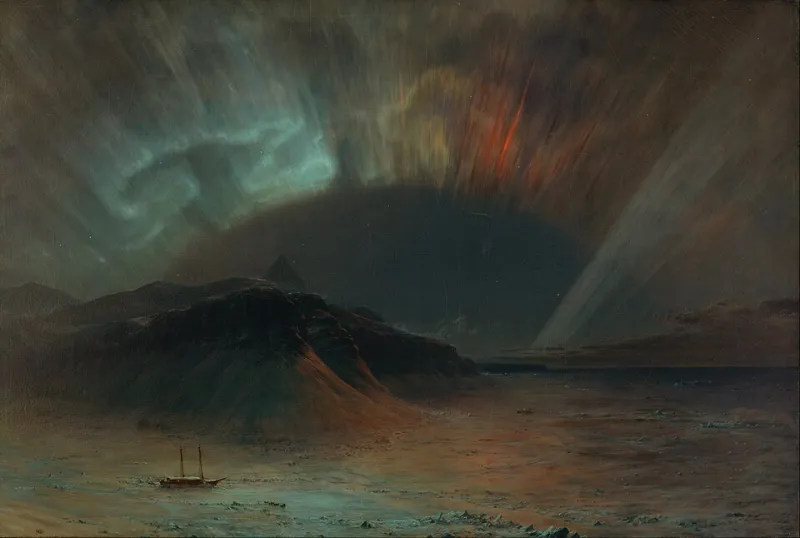
Photo: Frederic Edwin Church, Public domain, via Wikimedia Commons
Every collaboration hits the same small wall. A gallery asks for "the artist statement." Singular. One paragraph. Maybe 150 words. And suddenly two people who've spent eight months making something together are sitting across a table trying to remember how sentences work.
The usual outcome is a text that nobody hates and nobody loves. It says the work "explores themes of" something, and "interrogates" something else, and by the third line it sounds like it was written by a small charity that's had a difficult year. Both names go on the bottom. Neither of you would say a word of it out loud.
That's the thing worth fixing. A joint statement isn't a compromise document. It's a chance to say something only the two of you could say — because only the two of you were in the room.
Write alone before you write together
The single biggest mistake is opening a shared document on day one. What you get then is whoever types fastest, with everyone else editing reactively. The loudest voice wins by default and the text settles into that person's rhythms.
Instead, give each collaborator 40 minutes, separately, no talking, no group chat. Ask each of you to answer four questions in plain sentences:
- What is this thing, in one line, as if explaining it to someone at a bus stop?
- What did we each actually do? Not the concept — the labour. Who booked the room, who mixed the sound, who argued with the venue.
- What does the work believe? What's the argument underneath it?
- What would be dishonest to leave out?
Don't polish. Don't try for the gallery voice. Bullet points are fine, fragments are fine. You're mining, not building.
Then run a merge session with rules
Book 90 minutes. Put the four answers side by side in a document both of you can see. Then work in three columns: keep, kill, argue.
Keep is anything you both independently wrote something close to. That's gold — it's the shared truth of the project and it should form the skeleton of the statement.
Kill is the stuff that sounded good in the moment but neither of you meant. "Liminal." "Problematises." Anything copied from a previous application because it worked once.
Argue is the interesting pile. Argue is where you've described the work differently, or weighted different parts of it, or one of you thinks the piece is about grief and the other thinks it's about council cuts. Don't smooth that out yet. Sit with it.
A practical note: whoever is more confident with words will drift towards drafting the whole thing. Resist that, or at least name it out loud. If one person writes every sentence, the statement becomes their statement with a second signature attached. Split the drafting by section, swap, and edit each other's lines rather than replacing them.
Keep the disagreement visible
Here's a slightly unfashionable opinion: the best joint statements don't pretend the collaborators agree about everything.
Two people making work together will always see it from different angles — that's usually why the work is good. So let the text hold that. A line like "We came at this from different directions: one of us through the archive, one of us through the street" does more work than any amount of "we are united by a shared investigation into."
It also protects you. If a curator asks a question in the gallery and one of you answers it one way and the other answers it another, that's not a scandal. It's a collaboration. A statement that admits as much saves everyone a lot of awkward nodding.
What you shouldn't do is resolve a real disagreement by deleting both positions. If you can't agree on what the work is about, say that the work holds two readings, and name them. Vagueness is not neutrality. Vagueness is just a decision nobody signed off on.
Version control for humans
Small projects fall apart over file names. Make it boring:
- One owner per draft. One person holds the editable file. Everyone else comments, they don't fork it. Swap owners between drafts so it doesn't calcify into one person's prose.
- Name files with the date.
joint-statement_2026-03-04_v3_gc.docxbeatsstatement FINAL final2.docxevery time. - Keep a changelog in plain English. Three lines at the top of the doc: what changed, who changed it, why. It takes 30 seconds and stops the same argument happening twice.
- Freeze it before the deadline, not on it. Give yourself 48 hours of read-only time. Statements written in the last hour before a funding deadline always sound like it.
The tests that actually catch committee-speak
Before you send it anywhere, run these. They take ten minutes and they're ruthless.
The read-aloud test. Each of you reads the whole thing out loud, alone, in a normal voice. If a sentence makes you do a slightly different voice — a newsreader voice, a biennial voice — cut it or rewrite it.
The swap test. Each of you should be able to point at every sentence and say "yes, I'd defend that." Not "I don't object to that." Defend.
The nan test. Would you be comfortable if a family member with no interest in art read this and asked you what it meant? Not because art has to be simple. Because you should be able to answer.
The deletion test. Remove any sentence that could sit in any other artist's statement without changing meaning. If the paragraph survives, you've found your actual text.
The credit test. Does the statement make clear what each of you brought? Not in a CV way — in a way that means neither of you has to explain your own contribution at the private view.
Sign-off, properly
At the end, don't just ask for a thumbs-up emoji. Ask each collaborator to reply in writing with either "I stand behind this" or a specific line they can't stand behind yet. Both are useful. A silence is not a yes.
And put both names on it in the order you've agreed, not the order that flatters whoever is emailing the gallery.
The statement will go in a press pack, get cut to 80 words by someone else, and appear under a photograph that isn't your favourite. It'll have a short life. Which is exactly why it's worth an afternoon of proper argument — so that when it's the only thing a stranger reads about your work, it still sounds like the two people who made it.